
Practical Earthkeeping: Feathered Friends and Collateral Damage
How can we protect the beautiful birds who live among us?
This week, we are excited to share a piece from one of the regular writers you'll be reading this year - our friend and teacher, Dr. Joe Sheldon. Joe taught biology for 36 years, authored two books and many articles, and works with several environmental organizations. He lives on Whidbey Island, Washington with his wife, Donna. In this piece (originally published as part of Joe's Creation's Corner series for his church), Joe shares powerful experiences with large birds and invites us to consider our relationship to these wondrous creatures (and their smaller relatives). Thanks for reading - James and Louise, eds.
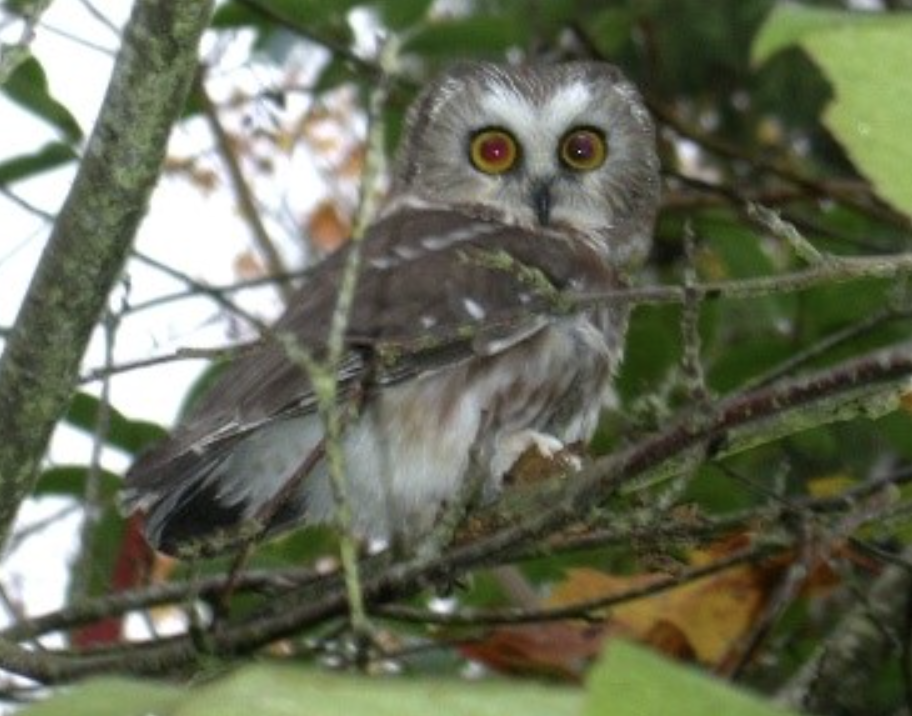
We had just driven through Port Townsend, Washington, when I spotted a small brown object on the roadside. My curiosity got the best of me, so I pulled over, opened the door, and walked back to what I thought was a small brownish bird – a roadkill, no doubt. When I stooped down and picked up the feathery mass, it lay limp in the palm of my hand. Then one eye opened! Then the other. It was stunned, but certainly not dead. What an amazing creature!
This small owl, a Northern Saw-whet, is common in northwest Washington, but not commonly seen. Here I was holding one in the palm of my hand. Then it stood up and looked at me. Soft, tender, precious, and utterly amazing! What a privilege. It was not long until my new friend spread its wings and swooped to a nearby bush where it continued to recover from its brush with death.
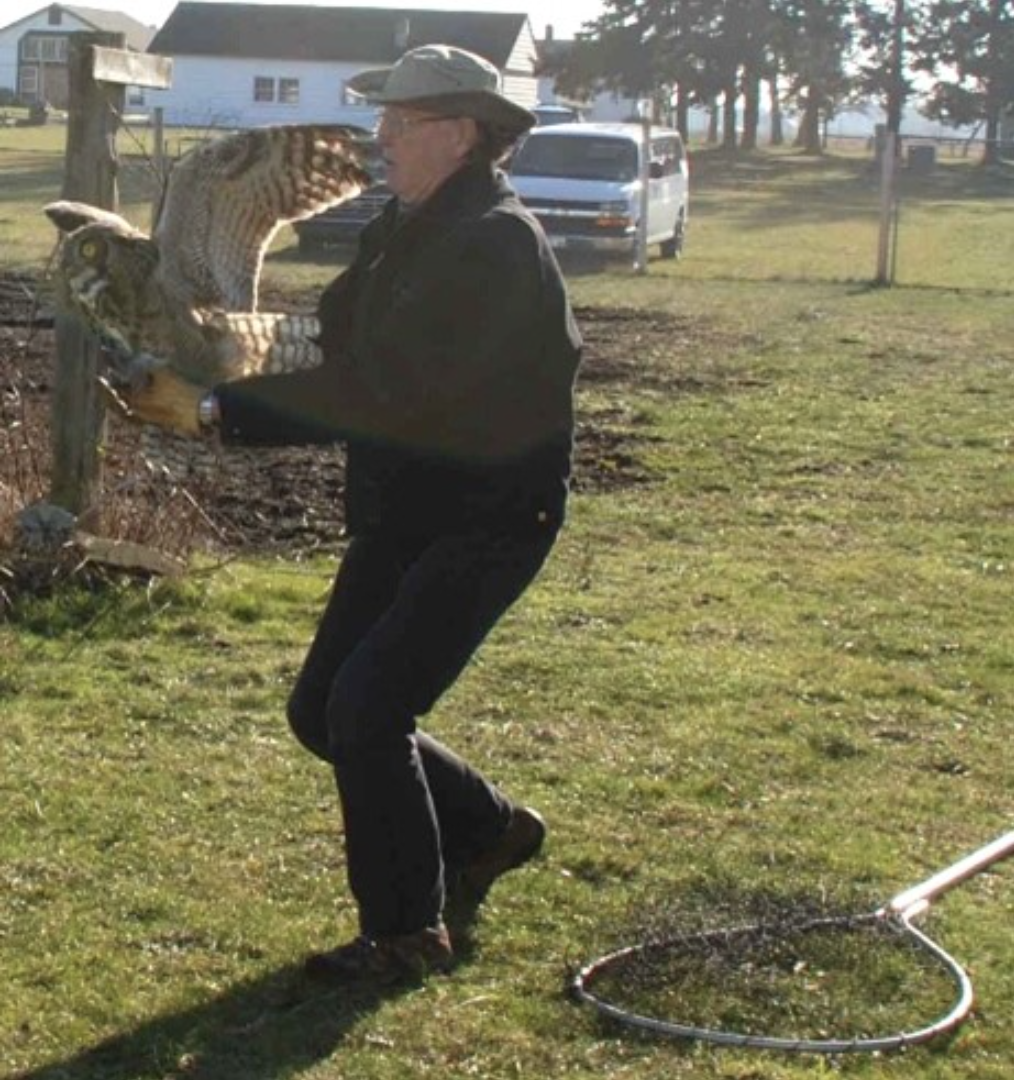
I have had other amazing encounters with avian friends. A few years ago at Pacific Rim Institute, when pheasants, chickens, and ducks were kept in coops next to the road, it was not unusual for large, hungry owls and hawks to find holes in the protective netting. On one occasion, a Great Horned Owl entered on what was clearly a feeding mission. Once discovered, I grabbed my salmon net, entered the cage, and netted the owl. I had to be careful to avoid the business ends – talons and beak! Once in the net, I took the owl out of the pen, chastised it for its bad (but normal) behavior, and released it.
On an Audubon trip to Malheur National Wildlife Refuge in southeastern Oregon that I co-led with my friend, Dr. Dave Parent, we encountered a very large Golden Eagle huddled over a snake in the middle of the highway. We exited the car and approached the bird. It attempted to fly from the road with its prey but could not gain altitude and landed nearby. We grabbed a blanket and were able to cover the eagle, subdue it, and get it into the car.
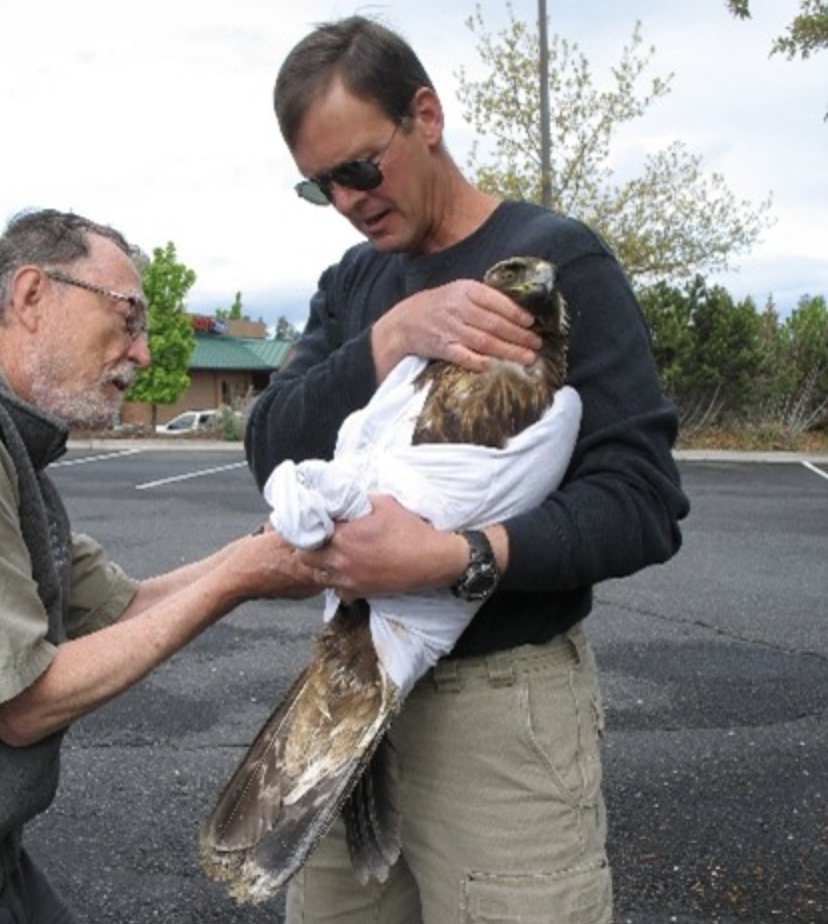
Dave is a veterinarian with a license to treat injured birds in Washington, but not Oregon. We connected with a raptor rehabilitator in Bend and took the eagle there. A careful analysis showed severe burns on one wing from the power line near the capture site. Unfortunately, the bird could not be saved. This magnificent creature had become a victim of collateral damage, electrocution from our energy network.
Such collateral damage is all too common. I have been “on call” for a couple of local vet offices when they receive a report of an injured large bird. On two occasions, the injured bird was a Bald Eagle. One was at a local wildlife preserve called Deer Lagoon, and my salmon net came in handy again. It was courting season, and the injured eagle was not at the top of the pecking order. The breeding season can be brutal, and injuries often occur. In this case they were minor, and the eagle, once treated by the vet, was released.
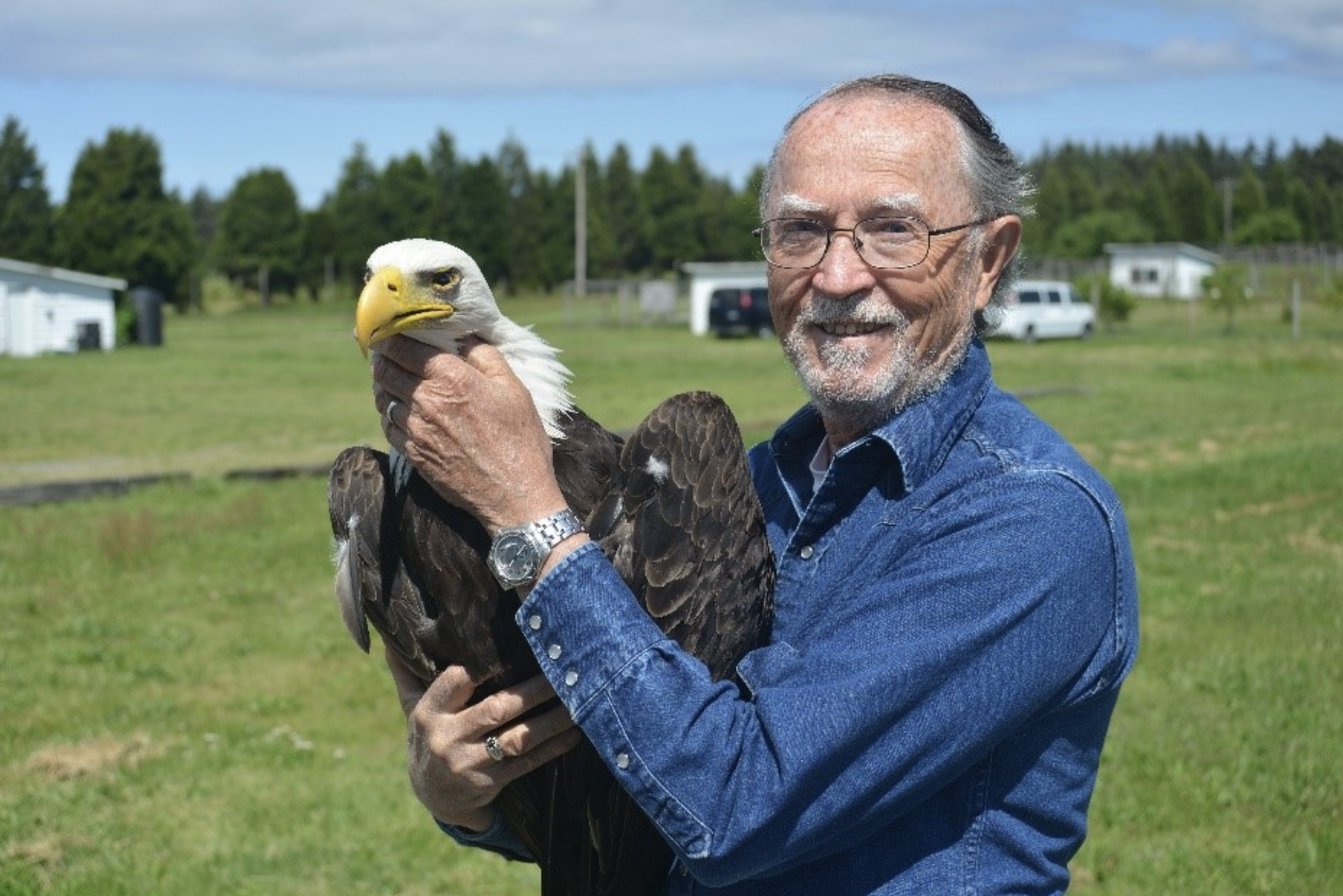
On another occasion, an injured Bald Eagle was reported near the Coupeville transfer station. It was lying under the power line and not in good shape—another victim of electrocution. The eagle was taken to Pacific Rim Institute, and we notified the proper authorities. The remains of such birds eventually go to local tribes that use the feathers and other body parts in their cultural ceremonies, thus completing a circle of life and avoiding the need to obtain healthy living birds.
Reducing Collateral Damage
The major causes of bird mortality include free-roaming feral cats and building strikes. It is estimated that cats kill 2.4 billion birds a year in the United States. Collisions with human structures (lighted tall buildings during migration and windows in our homes) take another one billion!
As stewards, these are areas we can address. Keep your cats indoors and do not support catch, neuter, and release programs for feral cats. Do not support or be involved with feeding stations for feral cats. Take steps to minimize window strikes at your home and place of work (for suggestions on how to do this, check out this Ecological Disciple piece). If you live or work in a tall building, it can be especially helpful to turn lights off during bird migration times.
Working together, we can make a difference. Remember Christ's words in Matthew 6:26: “consider the birds of the air.” Christ is not telling us to just casually glance at them – but to give them our special attention. If you have a moment today, I invite you to offer the following prayer: Oh Lord, thank you for the beautiful birds who share this magnificent world with us. We face many choices in our lives that impact their lives, and often those choices bring harm to our avian friends. We ask you for wisdom to make decisions that keep them safe and also reflect your love for all creation. Amen.
Thanks for reading,
Joe
You can learn more about Joe and his love for creation HERE.
The Ecological Disciple is part of Circlewood, an organization committed to "accelerating the greening of faith."
Comments ()