
The Art of Creation: Poems of Perspective
Our readers respond to our call for poems that give them hope.

A couple of weeks ago, I invited our readers to share a poem that give them perspective in times when hope is elusive. Below are the poems we received, along with each sender's explanation of the significance the poem holds for them.
From James Amadon
Work Song, Part 2: A Vision
by Wendell Berry
If we will have the wisdom to survive,
to stand like slow growing trees
in a ruined place, renewing, enriching it...
then a long time after we are dead
the lives our lives prepare will live
here, their houses strongly placed
upon the valley sides...
The river will run
clear, as we will never know it...
On the steeps where greed and ignorance cut down
the old forest, an old forest will stand,
its rich leaf-fall drifting on its roots.
The veins of forgotten springs will have opened.
Families will be singing in the fields...
Memory,
native to this valley, will spread over it
like a grove, and memory will grow
into legend, legend into song, song
into sacrament. The abundance of this place,
the songs of its people and its birds,
will be health and wisdom and indwelling
light. This is no paradisal dream.
Its hardship is its reality.
(From "New and Collected Poems", Counterpoint Press)
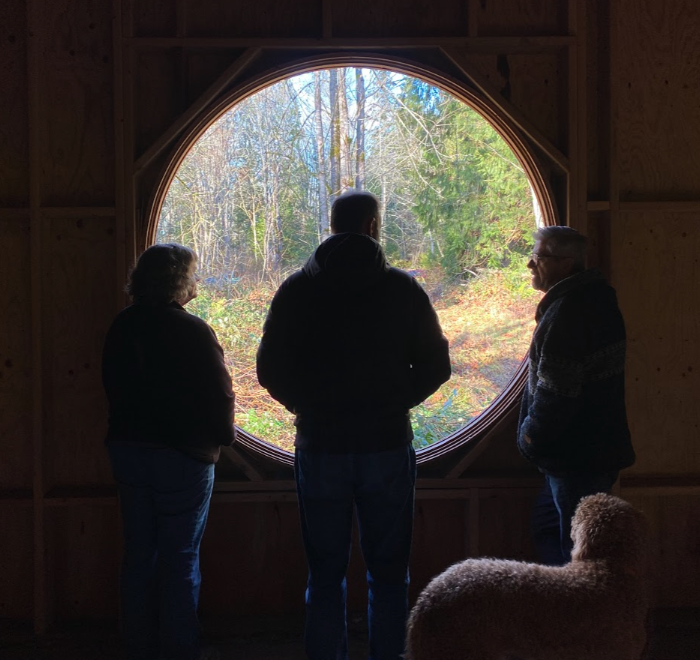
I have found that the poem “Work Song, Part 2: A Vision” by Wendell Berry gives me a measure of hope, patience, and determination as I experience the brokenness of the world. The poem reminds me that oftentimes the most important work we have is that which will not bear fruit until after we are gone – “the lives our lives prepare will live here.” This is especially important for my work with Circlewood, which seeks to cultivate the kind of lasting transformation the poem describes.
It reminds us that our job is to renew and enrich the places we live, creating the conditions for a future in which houses are “strongly placed,” rivers “will run clear,” and “an old forest will stand.” It is a vision of healing that makes way for possibility, even though we may never realize that possibility in our lifetime. The poem helps us see what that possibility looks like:
“The abundance of this place,
the songs of its people and its birds,
will be health and wisdom and indwelling
light.”
It ends by calling us back to the present with hopeful realism:
“This is no paradisal dream.
Its hardship is its reality.”

From Rosemary Green
To a Mouse
By Robert Burns
On Turning her up in her Nest, with the Plough, November 1785.
Wee, sleeket, cowran, tim’rous beastie,
O, what a panic’s in thy breastie!
Thou need na start awa sae hasty,
Wi’ bickerin brattle!
I wad be laith to rin an’ chase thee
Wi’ murd’ring pattle!
I’m truly sorry Man’s dominion
Has broken Nature’s social union,
An’ justifies that ill opinion,
Which makes thee startle,
At me, thy poor, earth-born companion,
An’ fellow-mortal!
I doubt na, whyles, but thou may thieve;
What then? poor beastie, thou maun live!
A daimen-icker in a thrave
’S a sma’ request:
I’ll get a blessin wi’ the lave,
An’ never miss ’t!
Thy wee-bit housie, too, in ruin!
It’s silly wa’s the win’s are strewin!
An’ naething, now, to big a new ane,
O’ foggage green!
An’ bleak December’s winds ensuin,
Baith snell an’ keen!
Thou saw the fields laid bare an’ waste,
An’ weary Winter comin fast,
An’ cozie here, beneath the blast,
Thou thought to dwell,
Till crash! the cruel coulter past
Out thro’ thy cell.
That wee-bit heap o’ leaves an’ stibble
Has cost thee monie a weary nibble!
Now thou’s turn’d out, for a’ thy trouble,
But house or hald,
To thole the Winter’s sleety dribble,
An’ cranreuch cauld!
But Mousie, thou art no thy-lane,
In proving foresight may be vain:
The best laid schemes o’ Mice an’ Men
Gang aft agley,
An’ lea’e us nought but grief an’ pain,
For promis’d joy!
Still, thou art blest, compar’d wi’ me!
The present only toucheth thee:
But Och! I backward cast my e’e,
On prospects drear!
An’ forward tho’ I canna see,
I guess an’ fear!
I am Scottish, but live in New Zealand and I love the poems of Scotland’s national poet, Robert Burns. He struggled through life, with ill health and poverty.
In this poem To a Mouse, he captures what I imagine the feelings could be of people who live in poverty, or sickness or in the war torn parts of the world.
A lack of hope.
When I read about the bombing and threats of bombing, that are in the news daily I would be surprised if the poor folk who live there have any hope left.
It should be easy for me, living in a peaceful place to see the beauty in nature and I do …. but a hope for peace in my lifetime for those poor folk is hard to find.

From Jessalyn Gentry
The poem that gives me hope has always been The Orange by Wendy Cope. My best friends and I all memorized it during high school and it's become really special to me and many of my loved ones. I actually have a tattoo in its honor. The photo is of my Christmas decor during a year we didn't have a Christmas tree; the dehydrated oranges of that season always bring the poem to mind, which is a lovely little light in the darkness of winter!
The Orange
by Wendy Cope
At lunchtime I bought a huge orange—
The size of it made us all laugh.
I peeled it and shared it with Robert and Dave—
They got quarters and I had a half.
And that orange, it made me so happy,
As ordinary things often do
Just lately. The shopping. A walk in the park.
This is peace and contentment. It’s new.
The rest of the day was quite easy.
I did all the jobs on my list
And enjoyed them and had some time over.
I love you. I’m glad I exist.
From The Orange and Other Poems by Wendy Cope, published by Faber & Faber LTD.
From Jeff Reed
Hamlen Brook
by Richard Wilbur
At the alder-darkened brink
Where the stream slows to a lucid jet
I lean to the water, dinting its top with sweat,
And see, before I can drink,
A startled inchling trout
Of spotted near-transparency,
Trawling a shadow solider than he.
He swerves now, darting out
To where, in a flicked slew
Of sparks and glittering silt, he weaves
Through stream-bed rocks, disturbing foundered leaves,
And butts then out of view
Beneath a sliding glass
Crazed by the skimming of a brace
Of burnished dragon-flies across its face,
In which deep cloudlets pass
And a white precipice
Of mirrored birch-trees plunges down
Toward where the azures of the zenith drown.
How shall I drink all this?
Joy’s trick is to supply
Dry lips with what can cool and slake,
Leaving them dumbstruck also with an ache
Nothing can satisfy.
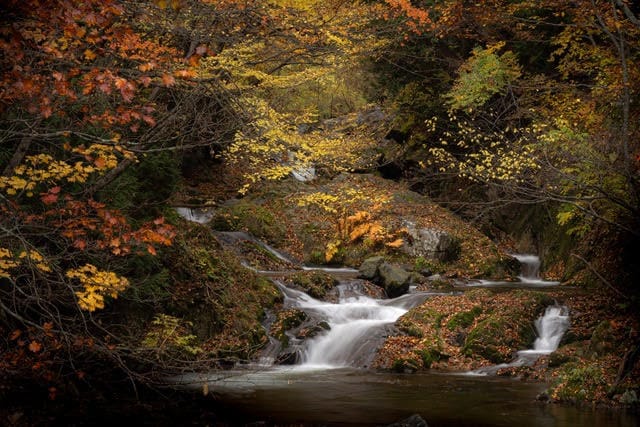
This poem reminds me of the sheer joy that is still available in the natural world around us, should we stop to notice and drink it in, and this is the kind of joy that only makes us thirsty for more joy of this kind, which can lead to a cascading of attention and care for the world in search of a better joy—as opposed to pursuing the lesser joys which most often involve some degradation of the fragile web of nature around us.
If one of the poems shared above helps you gain a new perspective, we would love to know. Feel free to leave a comment below (you can sign in through your email) or contact me directly at louise.conner@circlewood.online. We also encourage you to forward this piece to anyone you think might benefit from it—in fact, you can now share it directly to your social media account from our email or from the post's webpage.
Louise
IF YOU LIKED THIS, HERE'S ANOTHER TO TRY...
 Louise Conner, Editor
TO LEARN ABOUT OUR PARENT ORGANIZATION, GO HERE...


The Ecological Disciple is part of Circlewood, an organization committed to "accelerating the greening of humanity."
Comments ()