
The Art of Creation: An Abiding Membership
A farewell to author Wendell Berry and a celebration of his fictional world
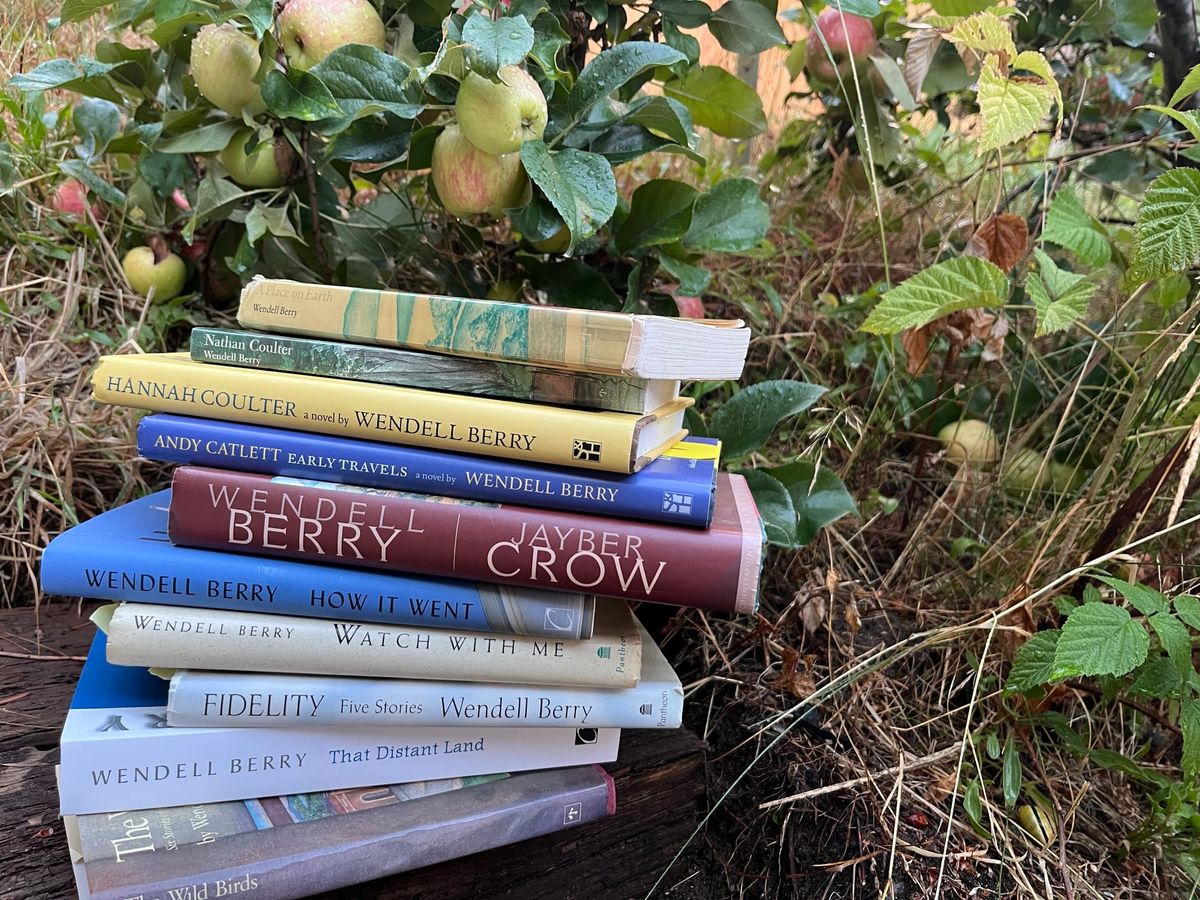
On Monday, we lost an author whose poetry, fiction, and prose have been companions to me for over 40 years. Wendell Berry’s books are the rare ones I buy in hardcover, too impatient to wait for the softcover publication. Introduced to Berry in the early 1980’s by a graduate student friend who was writing a dissertation on Berry, I was drawn into ideas and practices that seemed new and exciting, but which also articulated values I had seen in my parents and other members of their generation. These were values I hadn't really paid attention to or understood: frugality, integrity, quirkiness.
I’ve written twice before about Berry in The Ecological Disciple: once about his poem, The Peace of Wild Things and once about his nonfiction book, A Continuous Harmony. Berry's writing, whether his poetry, his nonfiction, or his fiction present a consistent world through different lenses and in different ways, so exploration of his work can begin with any of the genres.
The first book of fiction I read of Berry’s was aptly titled, A Place on Earth, apt because place is the central theme in his work. Although he has written much since then, I still believe that particular novel to be a good starting place for someone wanting to read his fiction, in part because of the wide range of characters (and their holdings) that are introduced within its pages. I also recommend reading more than one book from his fictional world since each story deepens and broadens the experience of Berry's storytelling. Side characters of one book become central characters in others; a piece of land referred to tangentially in one piece of writing is the main stage of another. It is like a painting in which detail and depth continue to be added with each layer of paint.

In his writing Berry has created a world centered around Port William, Kentucky, a fictional community shaped more by farms, crop rows, tree lines, and relationships than by streets or city limits. Even the stories that take place within town are continually referencing the places and farms to which the people in the stories are connected. The people are members of their places as much as they are members of their human community.
In one sense, membership is automatically granted to all who enter the Port William community, either through birth or relocation. As one character, Burley Coulter, puts it, "The way we are, we are members of each other. All of us. Everything. The difference ain’t in who is a member and who is not, but in who knows it and who don’t.” (Wild Birds, 1986, North Point Press).
This automatic membership is in some sense only a provisional membership, however, with full membership depending on accepting the hard work and responsibility of building relationships with people, the land, and the animals by bestowing care. Caring, in the sense of caring for, is what builds full membership. Caring is what binds people and place to each other through practices that strengthen the health of all. If a person doesn’t care, they may still exist as a nominal member, but only through the grace and forbearance of the other members.
Grace is offered expansively to others in Berry's world. You see it in the short story, Watch with Me, (1994, Pantheon Books), in which a group of neighbors trail behind a troubled man named Nightlife. He picks up a gun and wanders through neighbors' houses and farms with a dangerous lack of intention, poised to flare up like dynamite with a lit fuse. The neighbors trail behind him for a full day and night, close enough to watch and perhaps intervene if he should move toward harming himself or someone else. It is a moving picture of times when the gift of presence is the only gift that can be given. Unlike the gospel story in which the disciples fail to "watch" with Jesus in Gethsemane and fall asleep, these friends remain vigilant, following Nightlife in spite of the danger to themselves and the hardship it creates in their lives. They accept the burden of him because of his membership in their community.
In Berry's world, membership doesn't just involve humans. The land itself plays a part in accepting individuals into membership. When, through hard work, diligence, and love, those individuals show themselves worthy of membership by caring in a way that increases the health of a cared for piece of land or heals a piece of misused land, their character demonstrates itself worthy of the membership they have been given. Failures and foibles can be forgiven, but consistent mistreatment of land, people, or animals in one's care is a hard, if not impossible thing to forgive in Berry's view.
Part of what makes Berry’s principle of membership work is the recognition and acceptance of differences in both people and in the land. Those who understand their plots of land know what is required by each part of it, whether it be rocky hillside or rich bottomland. In the same way, different human personalities belong in different ways to the broad membership, each with their own strengths and their own weaknesses.
There are characters such as Burley Coulter, who belong deeply to Port William, but nonetheless have significant flaws. Although he has meaningful relationships with land and people and his work is of good quality (a virtue of high value to Berry), there are times when Burley just disappears for days at a time into the woods. Burley acknowledges this "waywardness" in a conversation with Wheeler Catlett, a very dedicated and responsible lawyer and part-time farmer who loves, but does not understand, Burley.
“It’s wayward, Wheeler. I knowed you’d say what you’ve said. Or anyhow think it. I know it seems wayward to you. But wayward is the way it is. And always has been...If we'd been brothers, you wouldn't have put up with me. Or anyhow you partly wouldn't have, because a lot of my doings haven't been your kind of doings. As it was, they could be tolerable or even funny to you because they wasn't done close enough to you to matter...I think you've got to forgive me as if I was a brother to you." (The Wild Birds, 1986, North Point Press)
Ultimately, membership in the community is lost only by resignation of that membership, through disavowal of people and place. In the story, It Wasn’t Me (1996, North Point Press), Clara Beechum Pettit, the daughter of Old Jack who was a much-beloved and respected member of Port William, and Clara's husband, Gladston, act in a way that signifies their resignation of membership in the community. In this case, it involves the willful ignoring of a Old Jack's dying wishes, a betrayal of land and people for the sake of money, and the refusal to listen to the voices of wisdom and age that are always on hand to offer advice to the younger inhabitants in Berry’s books. The Pettits turn their back on the values of rural membership in favor of the greed and glitz of the city.
Membership does not end with death in Berry's fiction. Some of the most significant characters of the membership exist only through the memories of others. Their wisdom and characters are kept alive through storytelling, with their foibles and mistakes as integral to the remembering as the stories of virtue and skill. The still-living members keep them alive in people’s memories, passing on stories of those they knew in person and those they only know in stories that have been also passed on to them.
In Berry's body of fiction work, generations come and go, along with older ways of farming and this should, in a way, have been preparation for our loss of Berry himself. His books are realistic about death with the losses felt both by the land and the people and carried forward to younger generations. These departures are painful, but Berry's wisdom reminds us that members are not lost as long as their stories and characters are remembered, their stories continue to be told, and their hard work on behalf of their place is upheld.

Whether there are any new stories left from Berry is yet to be seen, but if not, there is a large wealth of his stories to be retold, remembered, and absorbed. The first time I read Wendell Berry, my world shifted and I immediately looked for something to do that could mark this change. I looked with new eyes of frugality and discovery and found an apple tree strewing the edge of my parents' garden with unappreciated apples. I learned how to make and can applesauce that day and ever since I have seen more clearly the gifts that the land gives up so generously.
In a 1998 interview with NPR, Berry was asked to give advice to young people. He balked, but eventually added that, if at all possible, young people should look for opportunities to “stop some place, and stay there. Learn the history of it, and the names of the plants and animals and the neighbors.”
In other words, choose a place and make every effort to belong to it. Connecting to it deeply and inviting others to do the same can create a place where the membership Berry writes about can thrive in care, connection, and grace.
You can learn more about Wendell Berry and the books he has authored here or on Amazon.
Feel free to leave a comment below (you can sign in through your email) or contact me directly at louise.conner@circlewood.online. We also encourage you to share this piece with your friends using the share button provided.
Louise
IF YOU LIKED THIS, HERE'S ANOTHER TO TRY...
 James Amadon, Editor
TO LEARN ABOUT OUR PARENT ORGANIZATION, GO HERE...


The Ecological Disciple is part of Circlewood, an organization committed to "accelerating the greening of humanity."
Comments ()