
The Art of Creation: The Ancient in Our Midst
When something has lived for over 2,000 years, it must be doing something right.
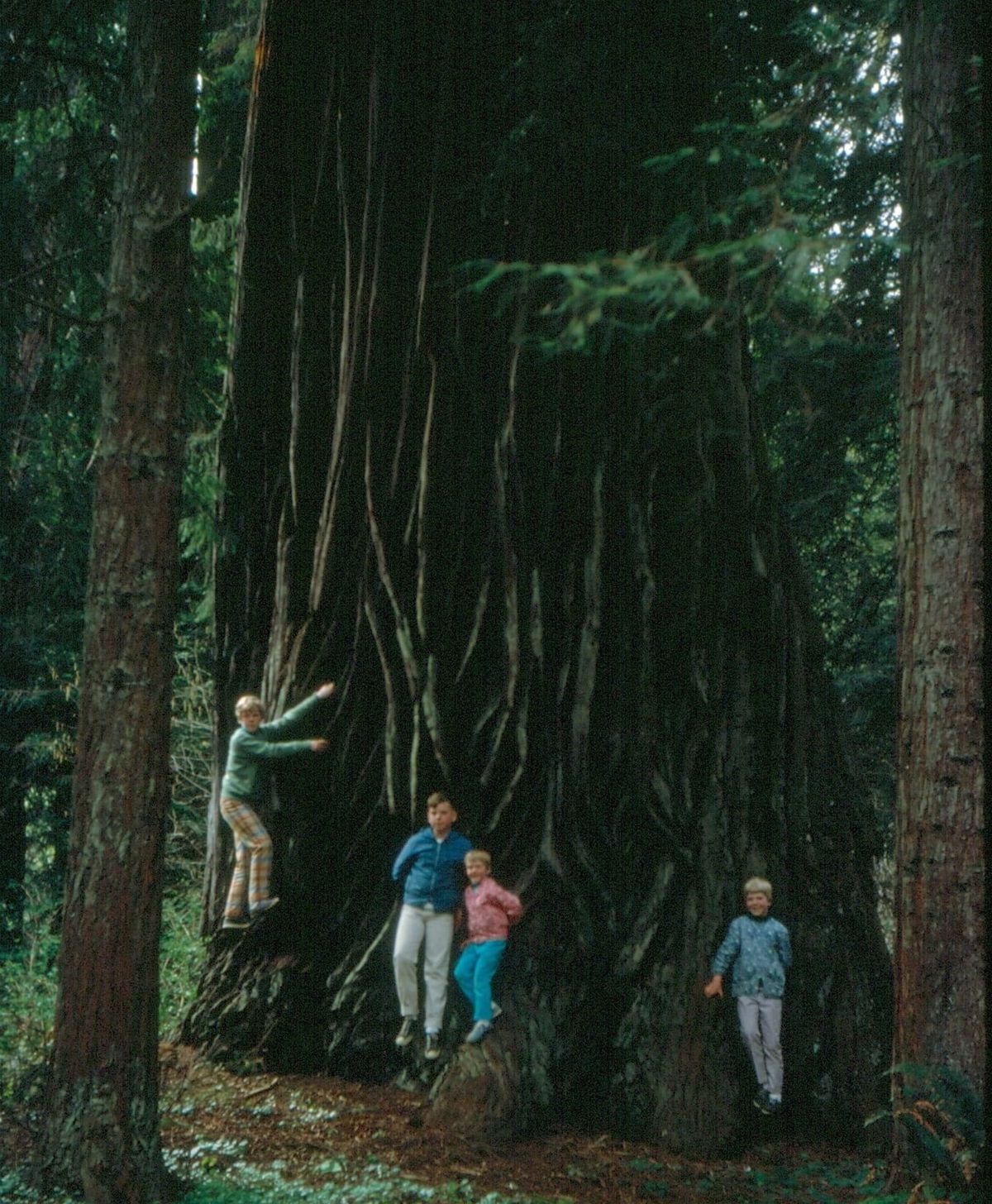
When you look at a very old human being, you can see the signs of age. Someone who is 100 looks different from when they were 30 or even 80. When I was seven, I saw my first ancient Redwood tree and remember leaning backward, trying to to see the top of a tree that seemed to go on forever. When I encountered my first Giant Sequoia, I stretched my arms as far as I could but could encompass only a minuscule amount of its enormous trunk.
But in Rachel Sussman’s book, The Oldest Living Things in the World, we see that not everything that is old, looks old. Some of the species in the book announce their age, like an ancient Sequoia or a 100-year-old human, but some you would pass right by, never suspecting their age.
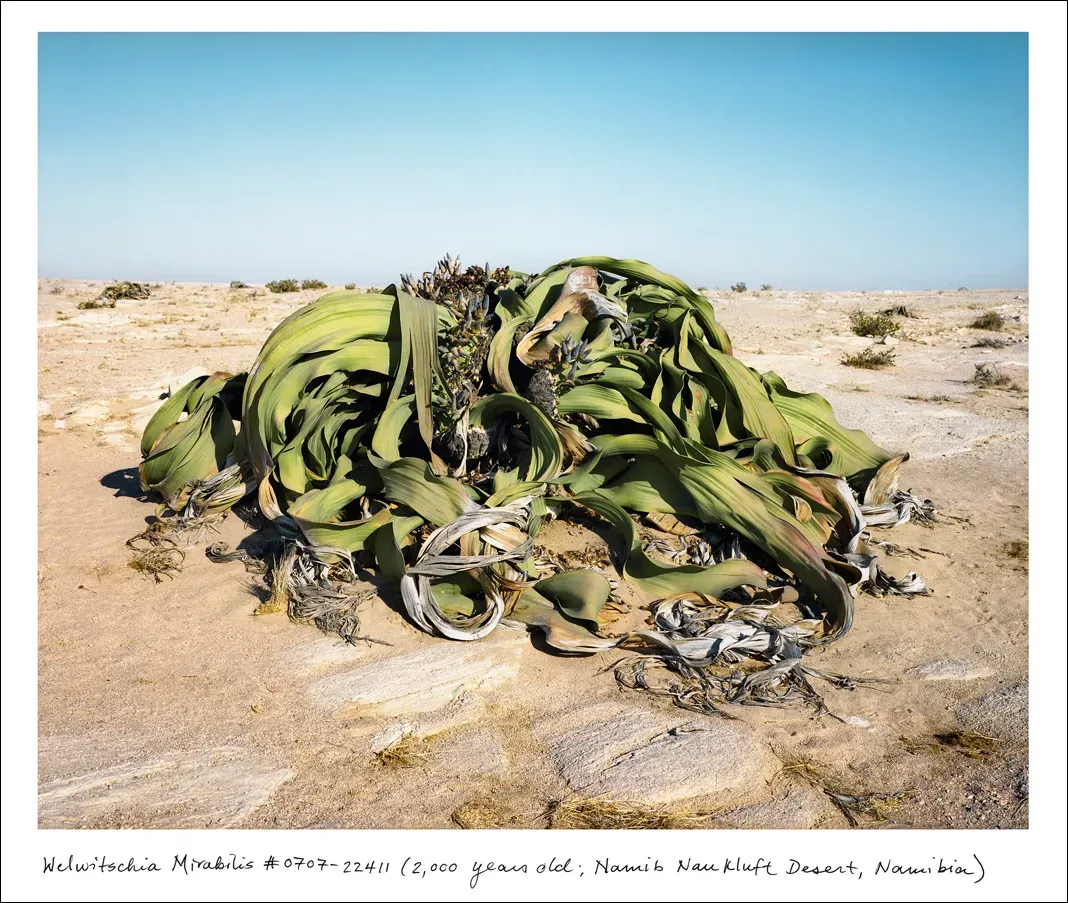
Sussman's exploration of the oldest living things began in 2004 and its scope reached across the globe. She planned to partner with a single scientist, but because there is no scientific specialty for studying longevity across species, she partnered instead with different scientists for each species. Her goal was to bring art and science together in a way that would benefit each
Each of the 30 organisms included in her 2014 book meet two criteria: they are at least 2,000 years old and they have been continuously living. Continuously living means DNA-based organisms and excludes those with extended periods of suspended animation or dormancy.
Sussman concedes that the huge scales of time in the book, or deep time, is difficult to grasp for creatures who see 100 years as a long lifetime. But, as Sussman writes, "Perhaps looking through the eyes of these ancient beings, and connecting with the deepest of deep time, we can borrow their bigger picture and adopt a longer view. I can’t think of a single problem in the world that wouldn’t benefit from the perspective of long-term thinking."
The organisms included are either unitary organisms or clonal colonies. (Some organisms are capable of reproducing by both methods). Unitary organisms develop from a single fertilized egg into genetically distinct individuals. Clonal colonies are genetically identical individuals growing in a given location originated vegetatively (not sexually) from a single ancestor.
It is relatively simple to determine the age of a unitary organism using methods such as core sampling or radiocarbon dating, but clonal colonies are difficult, since the original individual may not be present. Clonal colonies are often labelled as "at least" a certain age, based on what is known about the offspring clone.
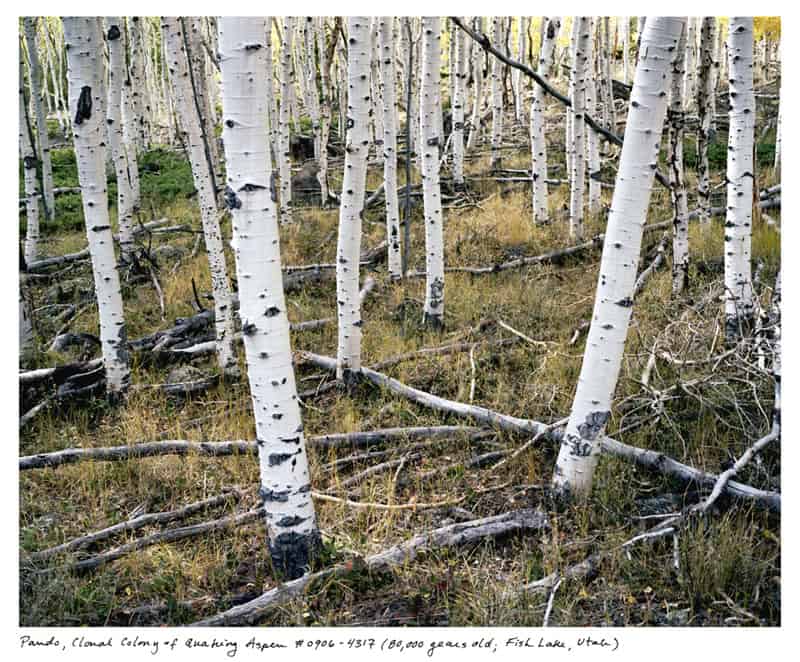
Pando is one of the most well-known of these clonal colonies. If you have ever had a lilac bush or a redbud dogwood in your yard, you have probably experienced its spread through suckers off the root system. Pando is a gigantic example of this type of propagation.
It inhabits 104 acres and includes 47,000 genetically identical trees, all of which are single stems sprouting from the same enormous root system. Due to its clonal structure, it can move nutrients from one tree to another when needed. It can also, very slowly, migrate if one area becomes unsafe or detrimental to growth or survival. Clonal reproduction doesn't require a mate, which for some species, especially rare ones, this can make the difference between survival and extinction.
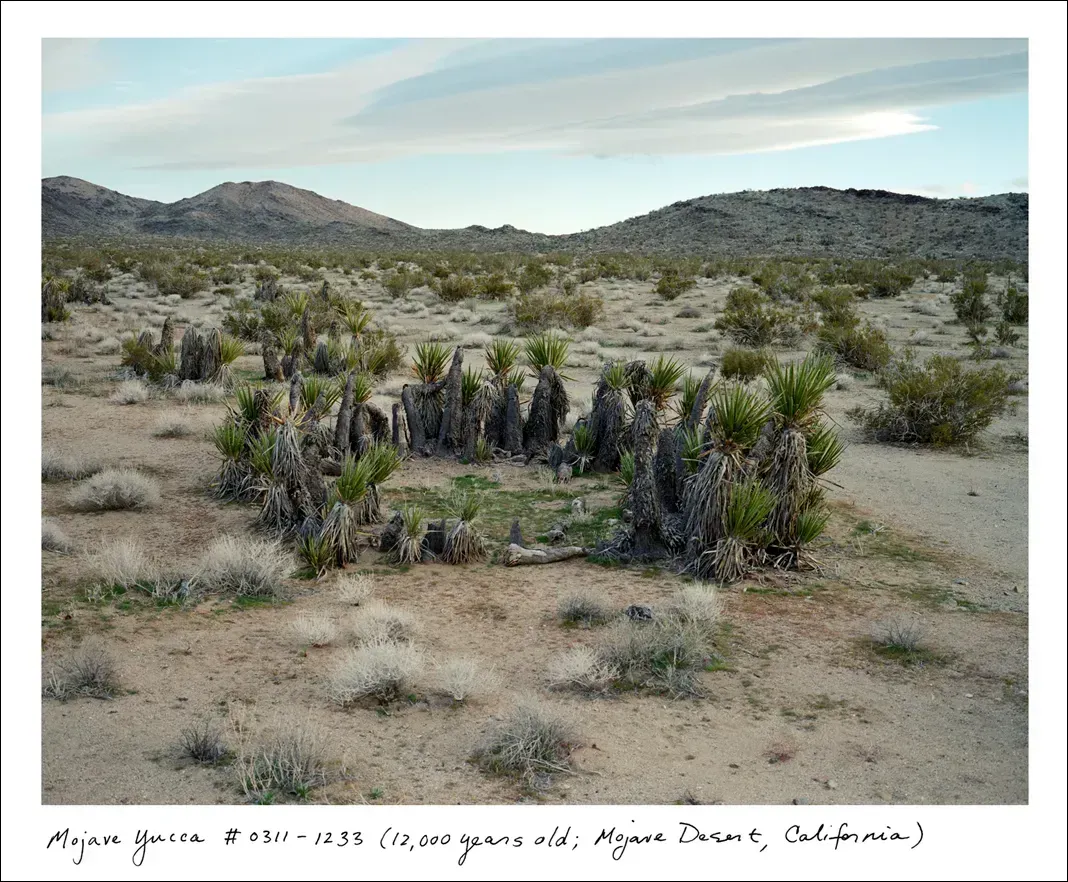
The Mojave Yucca and the Creosote Bush form clonal colonies with similar growth patterns. They both start with a single individual plant that grows outward. Given enough time, the central section ages and eventually disappears, leaving a ring of green vegetation around a central bare circle. This plant ring, which appears to be separate plants, is actually a single plant, encircling the space the originating vegetation once occupied.
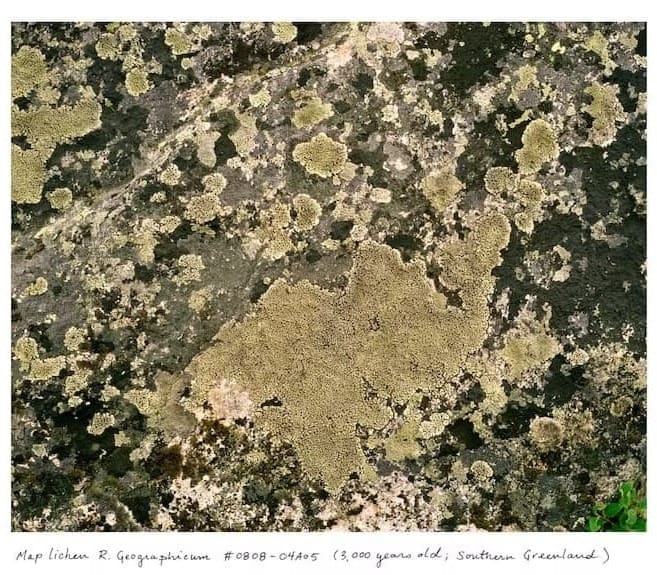
One discovery Sussman made is that organisms which grow quickly are not the longest-living survivors. Long life is enabled by the ability to fit into an environment and adapt, sometimes to extreme heat or cold or lack of moisture. The Greenland map lichen, for instance, only grows one centimeter every 100 years, obviously prioritizing stability over expansion.
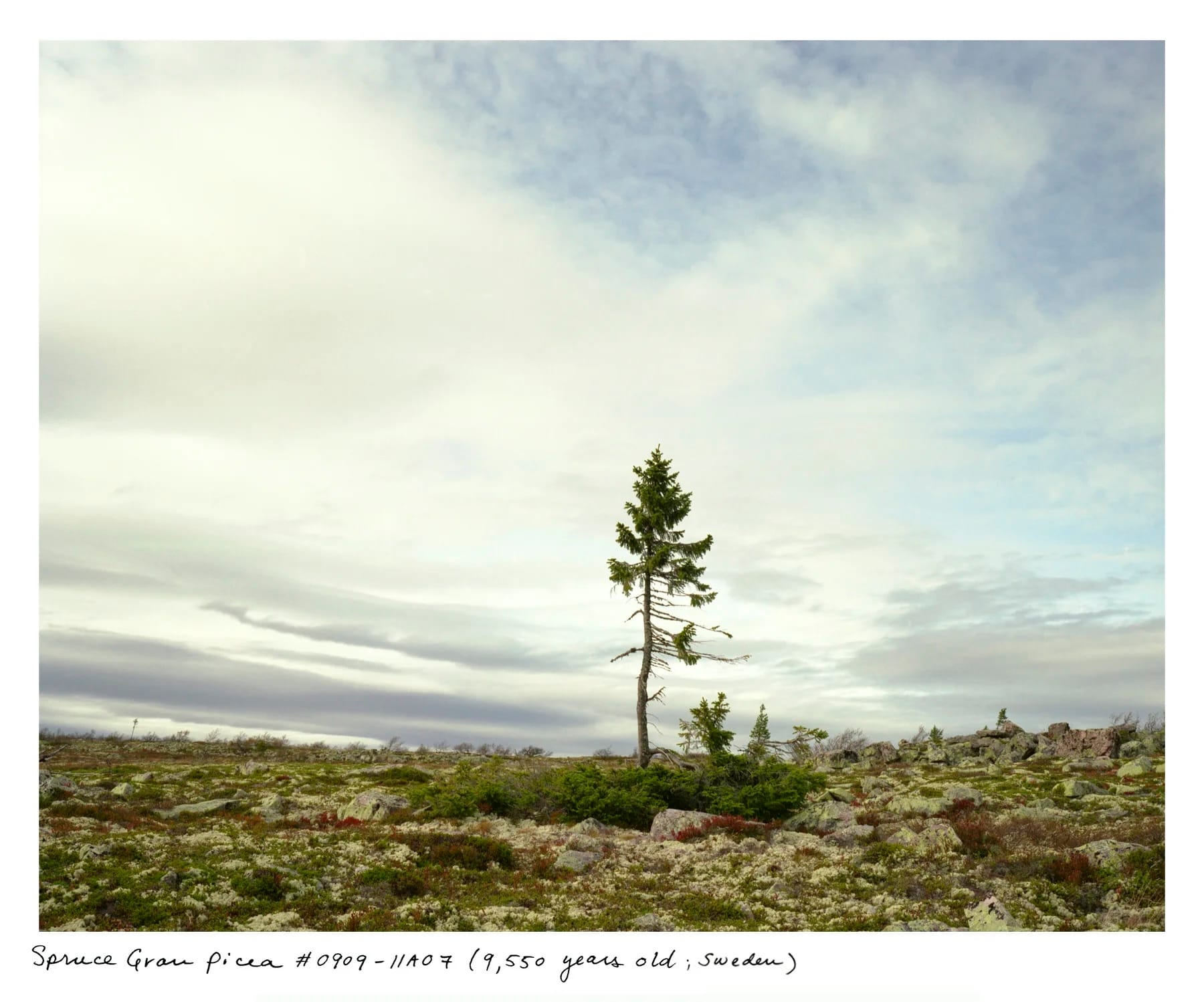
Changes in climate create the need for an organism to change its survival strategies. This can be seen in the photograph of the Spruce Gran Picea above. The low skirt of green is the growth of the tree for most of its 9,550 years, while the trunk growing up from the center shows the change it made when its environment began to warm in the late 1940's. It shifted from a low-lying bushy tree to one stretching upward with a few, spindly limbs around a trunk. The tree has adjusted, but it is likely that the quicker growth will also lead to less stability and longevity.
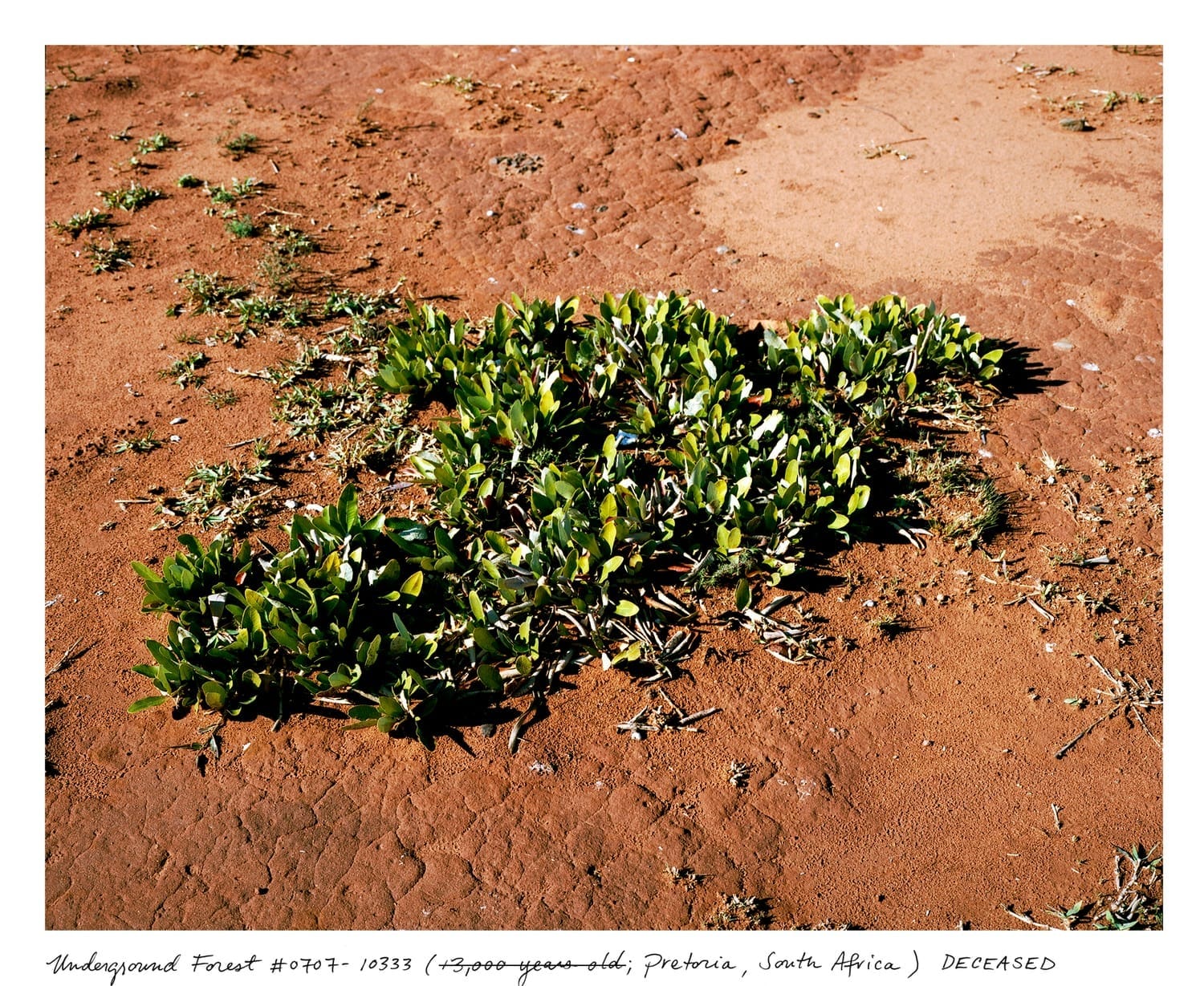
The underground forests in South Africa have coped to a difficult environment by migrating the bulk of their growth underground, leaving only the topmost crown of leaves visible and performing photosynthesis. The remainder of the tree is buried underground where it is protected from the frequent fires that burn through the area. When a fire sweeps in, the topmost leaves are burnt, but the bulk of the tree structure remains intact underground. This allows a quick re-sprouting of the leaf crown. These forests are often discovered only when a farmer or road construction crew ends up tangling their equipment with the trees' underground structure. The 13,000-year-old forest pictured above was killed when a roadway was routed through its center. Although the underground forests are numerous, they can't grow back if effort isn't made to preserve them—once a 13,000 year old forest is gone, it's gone.
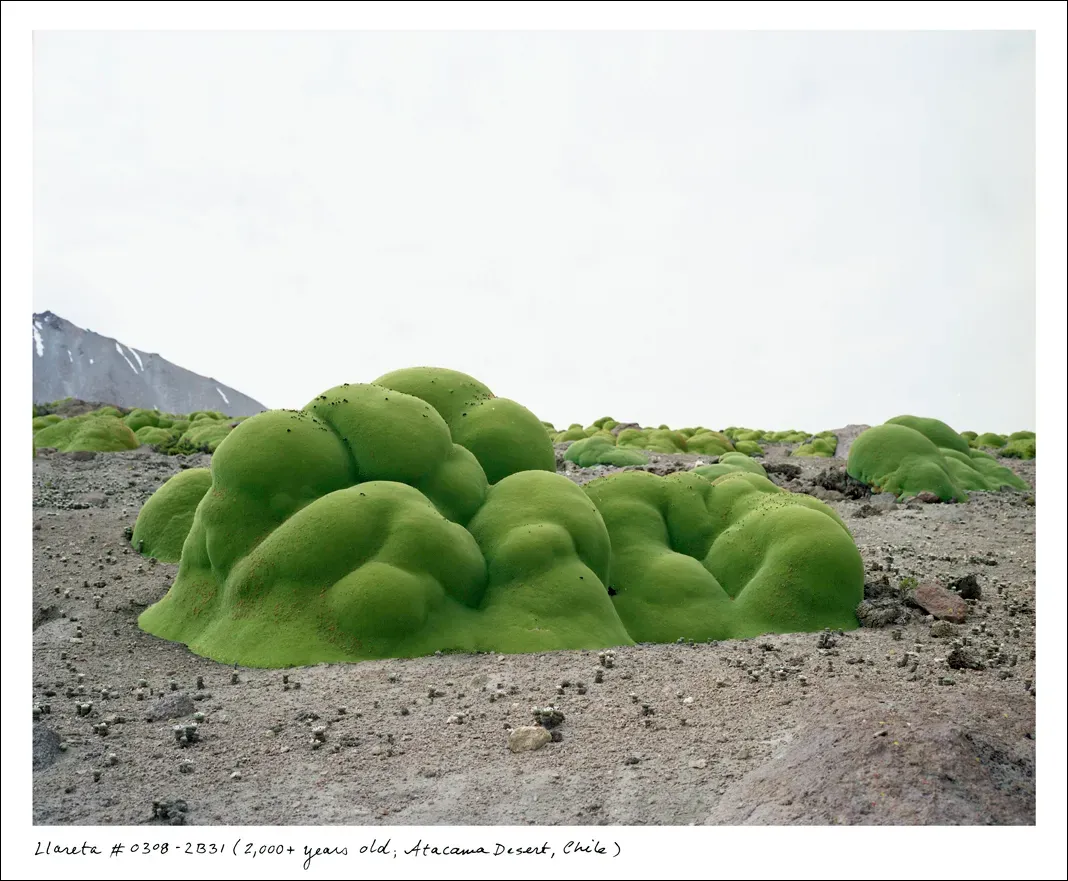
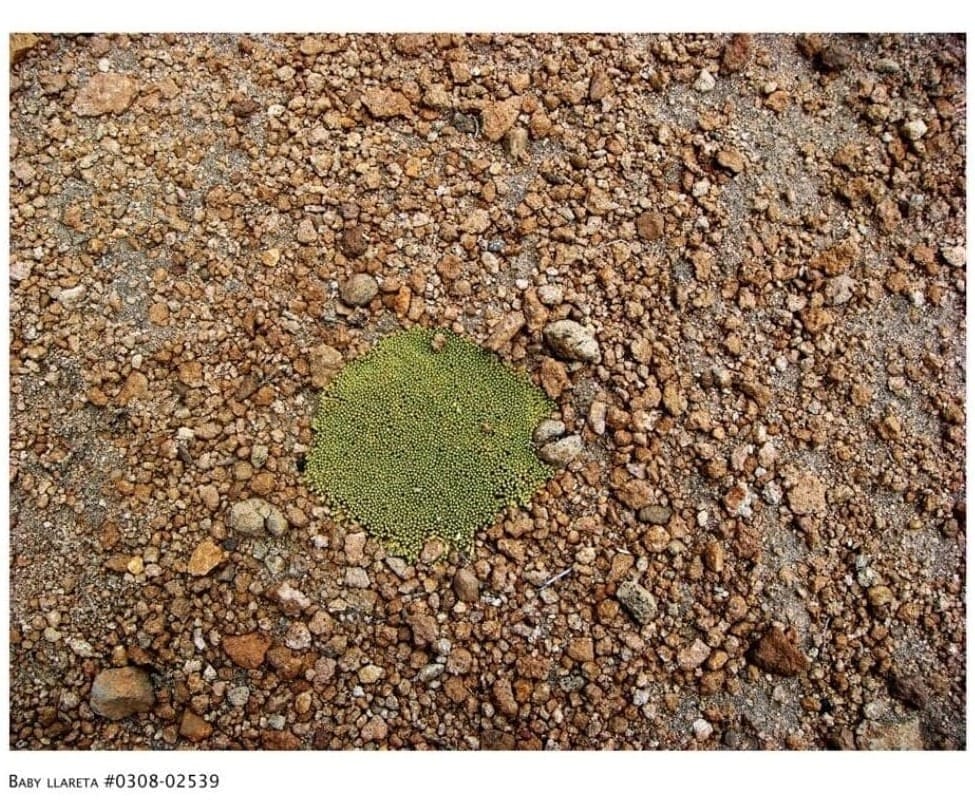
Photos and captions by Rachel Sussman, The Oldest Living Things in the World
The Llareta looks like moss covering rocks, but is in reality a compact shrub that creates a mat of tiny leaves dense enough to support someone sitting on top without falling through its canopy. It grows no more than a centimeter a year and results in a very dry and dense plant that, unfortunately for it, is an efficient fire fuel, used sometimes even by the park rangers assigned to protect it. Their slow growth rate, obviously makes this practice unsustainable; value must be assigned to these ancient things if we desire their continued existence.
One story Sussman tells is of a 3,500 bald cypress tree outside of Orlando that was burned down accidentally by someone using drugs inside its hollow trunk. Another story she relates is of a graduate student whose coring bit broke off in the middle of a bristlecone pine he was sampling in 1964. Because the tool was expensive, a park ranger suggested he just fell the tree so he could retrieve the tool. After all, there were many other trees of the same type in the area. After it was cut down, it was found to have been 4,844 years old—the oldest known unitary organism on the planet at the time. The incident sparked anger and resulted in greater protections for organisms like this tree, which was named Prometheus after its demise.
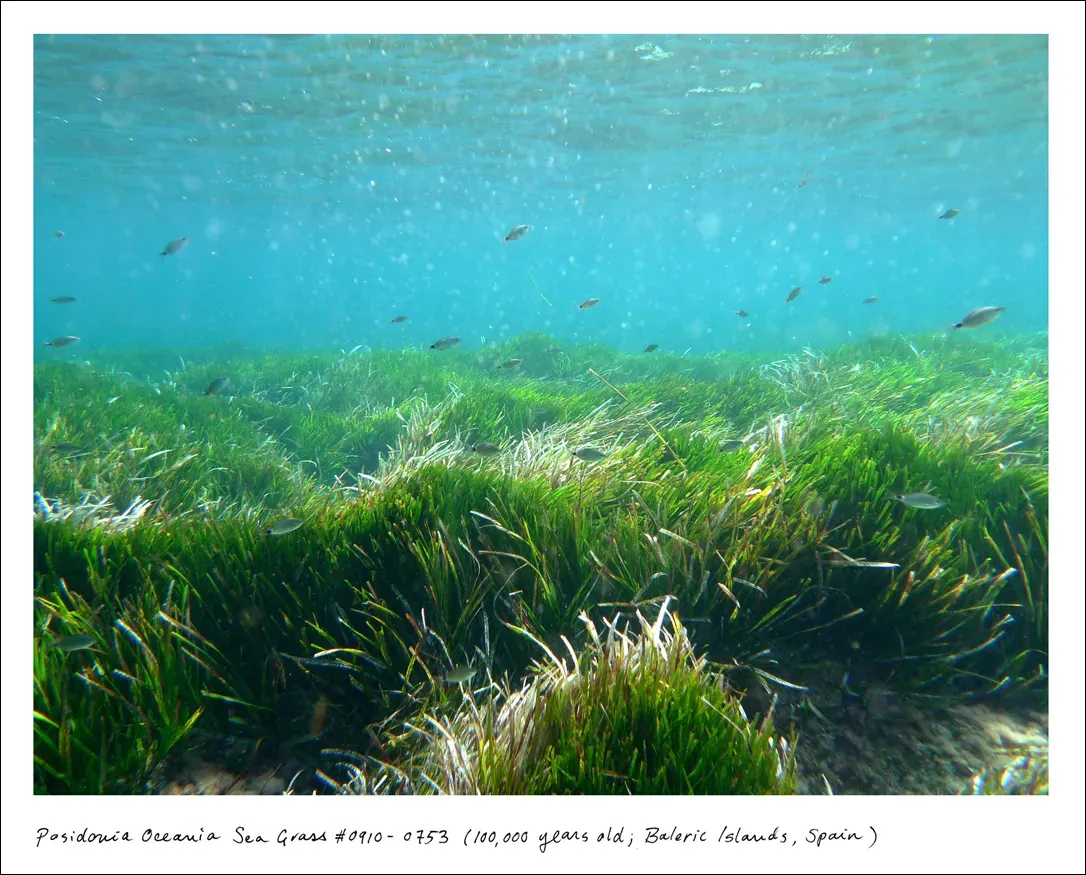
Each of the 30 species included in the book are fascinating: a 2,000-year-old brain coral that looks like the rind of a cantaloupe, a 100,000-year-old sea grass meadow that is all genetically identical and thus a single individual, ancient trees that are so large and hollowed out that an entire army is said to have fit inside the trunk of one of them (Chestnut of 100 Horses).
Through the images and the text, each organism tells a different story. By paying attention to their stories, we may achieve what Sussman hopes for—a wider, longer, bigger perspective that can help us answer the challenges we currently need to address in this world we are a part of.
I highly recommend you check at your local library for a copy of this fascinating book—I found several near me. You can learn more about the author on her website.
I would love to hear your thoughts in response to this. Feel free to leave a comment below (you can sign in through your email) or contact me directly at louise.conner@circlewood.online. We also encourage you to share this piece with your friends using the share button provided.
Louise
IF YOU LIKED THIS, HERE'S ANOTHER TO TRY...
 Noah Guthrie


The Ecological Disciple is part of Circlewood, an organization committed to "accelerating the greening of humanity."
Comments ()