The Art of Creation: Crossing
Re-connecting what cannot remain apart and still remain alive.
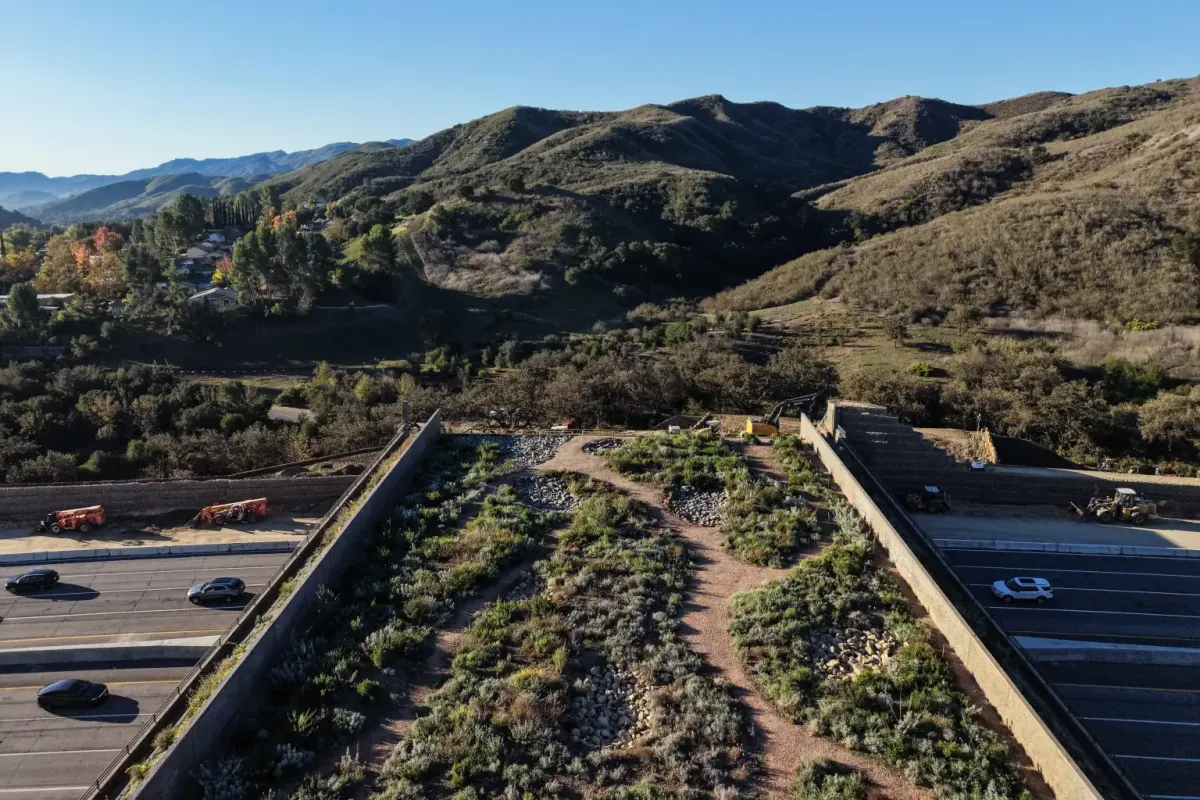
Two weeks from now, on December 2, a land bridge called the Wallis Annenberg Wildlife Crossing will officially open in southern California east of Thousand Oaks. Its main purpose is to reconnect two tracts of ecosystem that were bifurcated when the Ventura Freeway was built 60 years ago. Although this isthmus of land is not yet officially open, it has already become not just a passageway for wildlife, but also a home. Diverse animals and insects have found this carefully prepared expanse not just a suitable place to cross, but also a habitat in which to build webs and dig burrows.
This massive accomplishment of connecting the habitat and wildlife of the Santa Monica Mountains to the south with the habitat and wildlife of Simi Hills to the north is the outcome of years of research, financial contributions from public and private donors, buy-in from the communities involved, diligent work and cooperation between people and organizations, and a cougar who made the project personal to many.
The research began with a study on linking habitats in the 1990's and was bolstered by subsequent research of carnivores in the area, expanded to include mountain lions in 2002. The research on mountain lions in particular was alarming. Barriers affect the gene flow of all sorts of creatures from lizards to wrentits, but the cougar population in the area was particularly suffering due to genetic isolation.
"Inbreeding depression," in which signs of unhealthiness due to too small of a genetic pool for a species, was showing itself present in mountain lions, observable in recurring kinks at the end of cougars' tails and sperm quality issues in males. Often when such signs begin to appear, populations can crash very quickly, so swift action was needed to avert the extinction of the local threatened mountain lion population. This situation was a major spur for the crossing, along with the more standard reason for creating crossings—to reduce animal/car collisions.
Over the 30 years since the need and possibility of a crossing was recognized, organizations such as the Santa Monica Mountains Conservancy gradually but systematically acquired the privately held land located in the areas deemed the most feasible and effective place to create a crossing connecting the islands of habitat. But with 10 lanes of freeway to cross, there were many who believed the project was impossible to achieve. However, early funding from large private donors such as the crossing’s namesake, Wallis Annenberg, and actor Leonardo DiCaprio, as well as more than 5,000 other private and public donors, including the National Park Service and the National Wildlife Federation, made the $114 million project a reality.
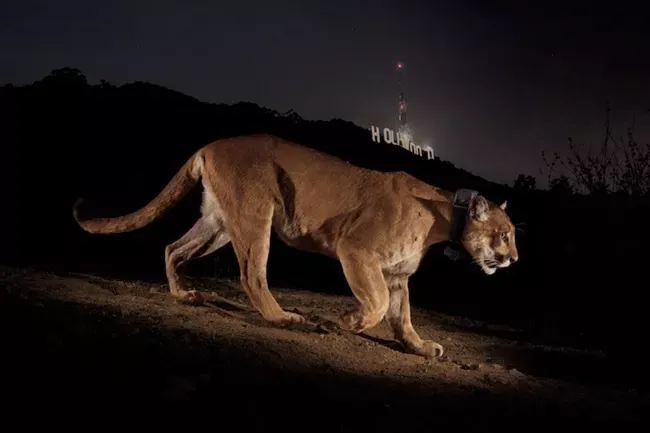
P-22, a mountain lion who crossed highways into the Hollywood area and lived for years in Griffith Park, raised public awareness and became the face of the campaign. The story of his life and the problems he experienced publicized the problems of urban predators. His eventual euthanasia due to severe injuries presumed to have been caused by a vehicle collision focused public attention on animals stranded by freeways and urbanization and turned him into emblem for the wildlife crossing campaign.
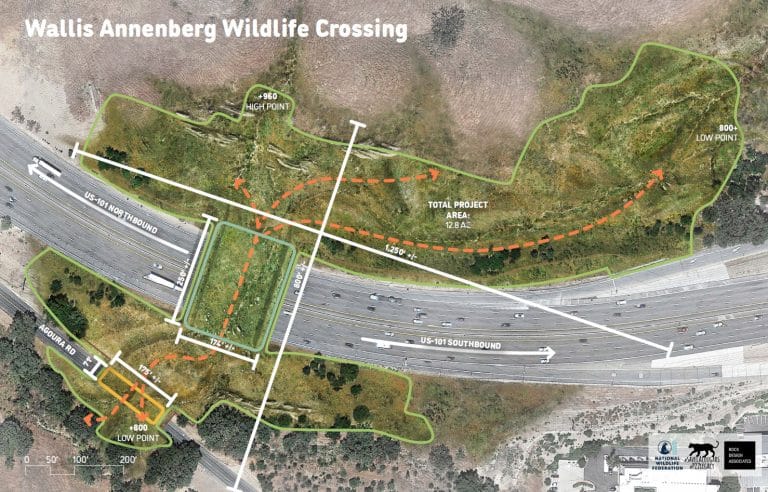
The crossing is composed of two structures. The largest segment is 210 feet long, 174 feet wide and crosses the 10-lane Ventura Freeway. The smaller segment is 71 feet long and 175 feet wide and crosses Agoura Road, a side road paralleling the freeway. The project incorporates acres of habitat on each side and fencing along the edges of the freeway to direct wildlife away from the lanes of traffic and toward the ramps sloping up to the crossing. Along the sides of the structure are 10-foot-high sound barriers to dampen the noise of the 300,000 vehicles that pass below daily and to block the glare of headlight for nocturnal animals crossing in darkness. Altogether the project encompasses over 13 acres.
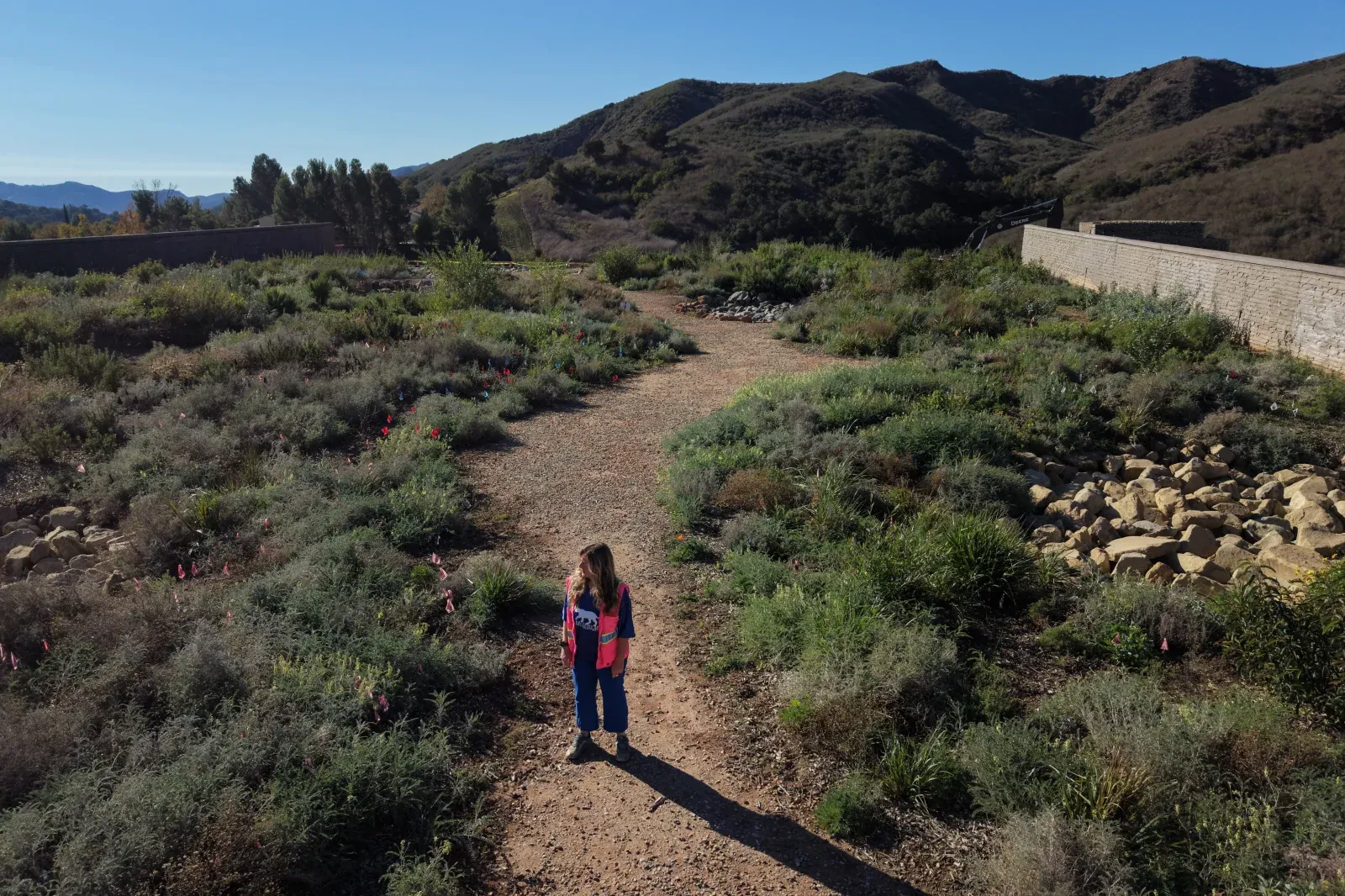
The surface of the crossing has been layered with local soil, rock and vegetation to match its surroundings, erasing differentiation for animals between the surrounding hillside and the manmade crossing. This has been accomplished over the past three years through the painstaking work of bringing in tons of local soil, cultivating plants from local native seeds, and growing trees endemic to the area. Native plants were planted a full year before opening to allow enough time for the plants to acclimate, grow, and create a mature landscape ready for native wildlife of all sizes and kinds to discover.
Since the groundbreaking of the project on Earth Day 2022, there have been cost overruns from the initial $92 million set aside for the project to the current estimated cost of $114 million. The rising costs are partially due to excessive rain for two years running, resulting in delays and price changes. Tariffs imposed by the current administration on some of the materials have also inflated the cost. Even so, the project has had consistently strong public support. Of the 9,000 comments submitted in response to the draft environmental impact statement, only 15 comments voiced opposition to the project.
Wallis Annenberg backed the project with $25 million and these words: "There’s a reason I wanted to support this crossing and issue this challenge: We need to move beyond mere conservation, toward a kind of environmental rejuvenation. Wildlife crossings are powerfully effective at doing just that — restoring ecosystems that have been fractured and disrupted. It's a way of saying, there are solutions to our deepest ecological challenges, and this is the kind of fresh new thinking that will get us there."
The Wallis Annenberg Wildlife Crossing is, according to many, the largest wildlife crossing in the world. It is also an accomplishment driven by a few passionate people who were able to communicate the need and the possibility in such a way that others were drawn into the enormous undertaking and expense. As a result, there is hope of mitigating a long-standing problem that could easily been given up as a non-solvable. But that isn't what happened. Beth Pratt, California regional executive director for the National Wildlife Federation and a primary force behind the project, was enormously encouraged when a coyote successfully made the trek across the crossing (even before the opening). Her goal now is to see a mountain lion cross.
Although the official opening of the wildlife crossing is scheduled for December 2, crossings are already happening. But Pratt says that for her, the real official opening will be when a mountain lion, a threatened species in California, makes its way to the overpass.
In the meantime, it's appropriate to celebrate this bit of restoration in a world that has been sundered by so many things. May we learn how to better maintain the wholeness of that which cannot be divided and still thrive.
Louise
Comments ()