
Practical Earthkeeping: Aromatic Ecological Discipleship
Scent can deepen our relationships with the created world and help us recognize where creation is hurting.
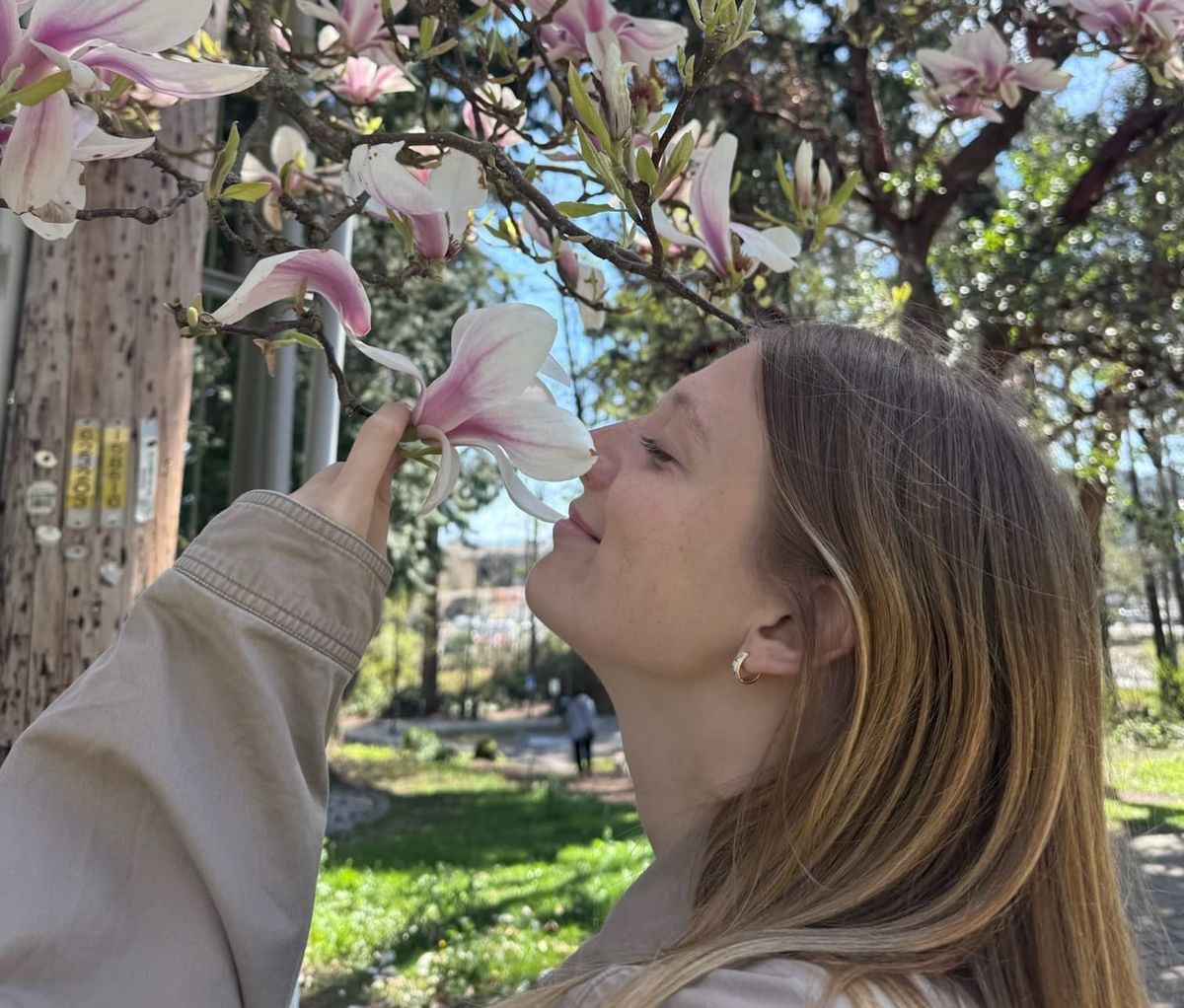
Today we share a post from Allison Gilmeister, Circlewood's 2026 Ecology and Faith intern. Allison is pursuing a Master of Arts in Religion and Ecology at Yale Divinity School, where she explores the intersection of environmentalism and Christianity.
Kaukauna, Wisconsin is not the place for a leisurely, widows-down joyride. Any unknowing passerby will, without a doubt, make the same disgusted face as they cross the city line, their windows promptly rolling shut. Locals call it “the scent of money;” I think a more fitting title would be “the scent of desecration.” Kaukauna has not always smelt like sewage, industrial combustion, and rotten eggs. These scents have been created by humans who first needed a paper mill, and then later, somewhere to destroy its steadily increasing stream of waste.
The ability to smell can often feel like a blessing and a curse. For me, scent is a blessing whenever I’m near cedar. One whiff transports me to a field trip of my youth, deep in the woods, as my teacher churned fallen scales of cedar in his palm. A draft of lilac and I’m back in my childhood home, screen doors slung open with joy at the first signs of spring. On the other hand, I am not as fond of the smell of gasoline, cigarette smoke or… the vigorous exhaust they call air in Kaukauna.

God, Scent, and Creation
Reading Genesis, we find that God, too, has smell-based opinions. In Genesis 8, after the flood, Noah sets up an altar in worship of God. The text states that when God smelled the “pleasing odor” of Noah’s altar, God said in his heart that he would never again curse the ground or destroy every living creature (Genesis 8:21). This leads to a covenant God makes with “all flesh” in Genesis 9: “As for me, I am establishing my covenant with you and your descendants after you and with every living creature that is with you, the birds, the domestic animals, and every animal of the earth with you, as many as came out of the ark”(Genesis 9:9-10).
This is an extremely important passage for those who aim to read the Bible with an ecological hermeneutic: the first explicitly named covenant of the Bible is made with not just humans, but all creatures who roam the earth. There is nuance to this concept, though, considering Noah’s altar required the sacrifice of innocent animal lives. It’s important to remember that in the ancient world of Genesis, animal sacrifice wasn’t seen as cruelty, but as the best fate an animal could have, for its life was being returned directly to God. The text does not detail God’s ethical perception of this sacrifice. What it does tell us is that scent is how God first encountered the new, post-flood creation. It’s at this moment that God made a choice—one that was for creation holistically—a promise that put life and regeneration over destruction.
Nose-First Earthkeeping
Smell may not be the first thing that comes to mind when you think about your own earthkeeping journey. And yet, like Noah’s God, we too can enter into a more active engagement with the scents around us. As I see it—or should I say, smell it—scent can both deepen our relationships with the created world, and deepen our ability to recognize where creation is hurting.
When I close my eyes and envision laying in a field of wildflowers, or skittering with the sea crabs along rocky pacific shores, the first thing I imagine is the distinct, aromatic smells of these places. Like the field trip where I first learned the scent of cedar, scents hold our memories of kinship or connection with the natural world. In nature, we usually do not need a written explanation to “learn a scent” and recognize where it comes from. This is something different: an embodied type of knowing that redefines one’s experience of the other in creation. This lies beyond the bounds of books—unless cedar scales and Nootka petals are pressed between their pages!
Nature’s more unpleasant smells also hold an important place in this conversation. For example, the scent of decaying algae at the beach, or food being composted, may make your nose crinkle. However, when we understand why decomposition is a necessary part of creation’s flourishing, our immediate “yuck” reactions can be transformed into a more nuanced appreciation of creation’s complex beauty.
On the flip side, scent also offers an avenue into recognition of disorder in our interconnected web of being. Although Kaukauna’s stench has yet to result in formally recorded environmental or human health damages, this is not the case for many of the most industrially polluted cities across the US. Large-scale landfills, industrial waste facilities, paper mills, chemical plants, and factory farms often have severe impacts on surrounding ecosystems and human health. Further yet, the siting of these facilities is far too often done in low-income, predominantly minority neighborhoods. Not only do these sites produce odors that inhibit access and enjoyment of natural spaces, but they also work to infiltrate and destroy the human and more-than-human bodies of the ecosystems they’ve been haphazardly grafted into.
The Fragrance of a Better Future
God’s covenant with all fleshly creation, sprouted from fragrance, shows us the apparent power of scent when it comes to biblical creation care. This intricate, God-given, evolutionarily developed sense of scent has not been fully realized from an earthkeeping standpoint. How are we to model our ecological discipleship after God, taking scent seriously as a mechanism for encountering creation, and living into God's call for flourishing of the earth, over destruction?
This “aromatic ecological discipleship” we could call it, can be entered by two, converging paths.
First, noticing where the “bad scents” are in our cities and states, doing research, when we can, into where these scents are coming from and if they’re harming the surrounding community. There are environmental justice non-profits and legal organizations that need citizen help to hold destructive industries accountable. In McKiver v. Murphy-Brown, a 4th Circuit Court case in 2020, over 500 neighbors of a factory farm sued and won damages under nuisance law, the case relying on the scent and noise from Murphy-Brown’s facility. The beautifully varied aromas of creation have no owner but God; everyone deserves a full and healthy life, lived long enough to smell them.

This leads to the second step, which is to re-enliven the old phrase, “Stop and smell the roses.” We cannot let the consumeristic hustle of 21st century life keep us from slowing down long enough to appreciate the pleasing scents creation offers. Cherish the grassy knolls, the towering pines, and even the skunks along your path. You can take them in through your nose without actually taking anything at all, keeping them as olfactory memories of creation’s goodness and proper flourishing.

We cannot let these memories be forgotten, for folded within their contours is the rugged, smelt experience of hope: hope for a world where everyone can breathe clean air, drink clear water, and drive through Kaukuna with their hands out the sunroof.
Comment below or email me directly at allygilmeister (at) gmail.com.
Allison
IF YOU LIKED THIS, HERE'S ANOTHER TO TRY...
 Louise Conner, Editor
TO LEARN ABOUT OUR PARENT ORGANIZATION, GO HERE...


The Ecological Disciple is part of Circlewood, an organization committed to "accelerating the greening of humanity."
Comments ()