
The Art of Creation: Ancient Wisdom for Modern Hubris
Ancient wisdom declares without ambiguity that ecological destruction will reap heavy consequences not only on those swing the axe, but also on all the innocent bystanders as well, especially the poor and vulnerable among us.

Today we welcome back Circlewood friend, Jeff Reed, as a regular contributor for The Ecological Disciple. Jeff serves as the pastor of Highland Covenant Church in Bellevue, Washington and manages Wind in the Reeds Press, a small publishing enterprise. You can find Jeff's previous posts for The Ecological Disciple on his author's webpage here.
Thus says the Lord, “Stand by the roads, and look, and ask for the ancient paths, where the good way is, and walk in it, and find rest for your souls. But they said, “We will not walk in it.”
Jeremiah 6:16
One might assume that the dire warnings of catastrophic consequence proclaimed loudly today to those who are exploiting the environment are a contemporary product of our unique time in history, sparked by the precipitous line toward which we are drawing near. Against this assumption, I recently came across an ancient story which displays this same prophetic grist as far back as the 6th century B.C. I speak of the famous myth of Erysichthon, first mentioned in Pseudo-Hesiod’s poem, The Catalogue of Women. It appears again in Callimachus’ 3rd century B.C. Hymn to Demeter, and again, and, most famously, in Ovid’s Metamorphoses in the first century C.E.
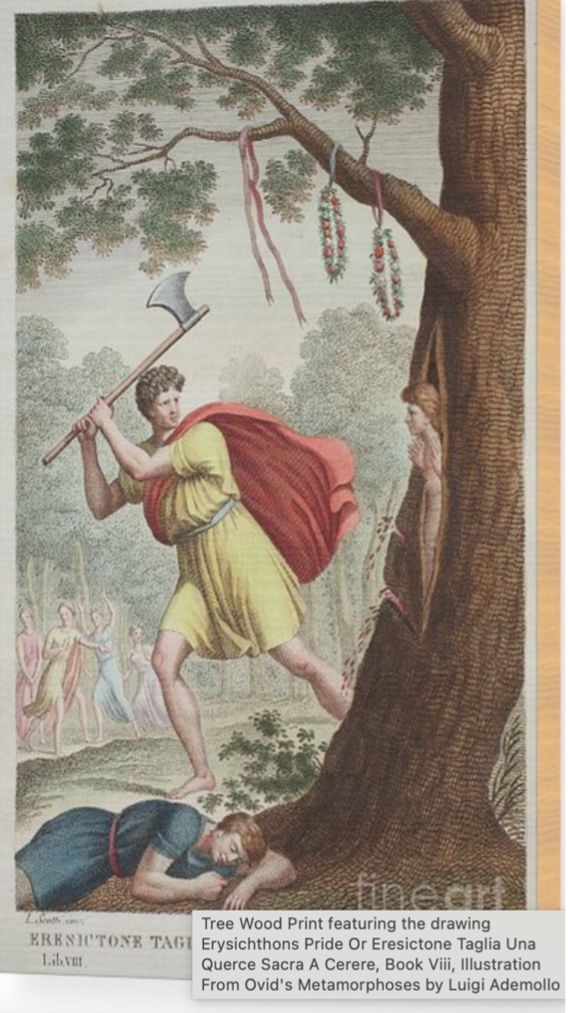
The simple outline of the story is as follows: Erysichthon is the greedy king of Thessaly who enters a sacred grove of trees in search of timber for his house. Against the instincts of all of his men (who refuse to do his bidding), he chops down the great oak in the middle of the grove, in which lives a tree nymph who calls out for justice as she is dying. The goddess of harvest and health, Demeter (Ceres in the Roman mythologies), commands the spirit of famine to infect Erysichthon as punishment for his arrogance and greed. His life turns into a hopeless quest to satiate his hunger, with everything he consumes only increasing his appetite. He burns through all of his possessions until finally he ends up selling his own daughter for food. And when that proves insufficient, he finally turns on himself, gnawing on his own limbs, until in the end he consumes his very self.
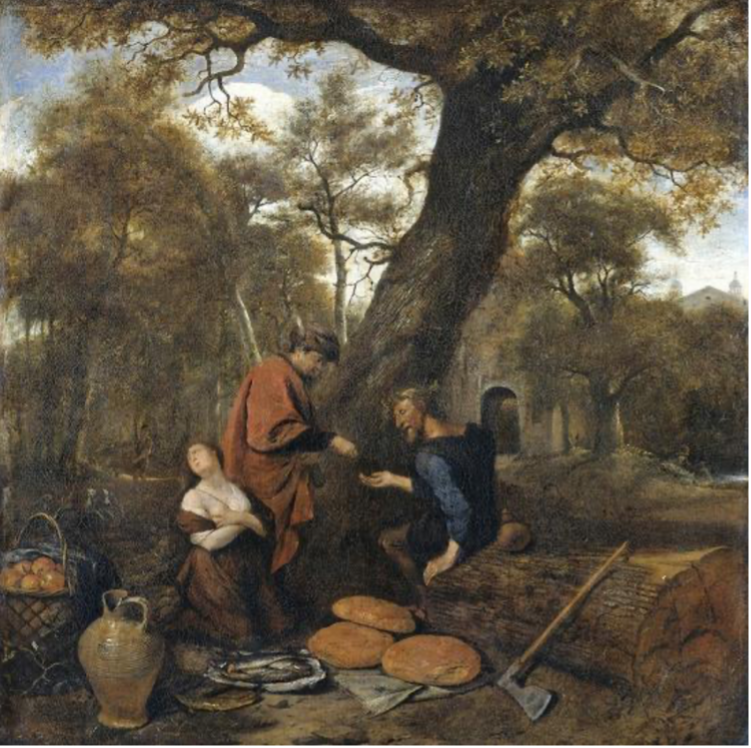
In 1997, the British Poet Laureate Ted Hughes translated and published a collection of 24 free-verse stories from Ovid’s Metamorphoses entitled Tales from Ovid. Among these, once again, is the tale of Erysichthon. Hughes’ modern translation takes this ancient grim tale and re-presents its powerful images and ideas to speak to the drama of today’s peril. There are several stanzas from Hughes’ translation of Erysichthon that I want to highlight as holding particular prophetic poignancy for the moment we are in. Even now, the United States government, under the current administration, is undermining years of progress in environmental policy as it insists that climate science is nothing more than a hoax. It recently repealed the science-based “endangerment finding” which formerly served as the anchor rational for government regulation of industrial air pollution.
In stanza 14 of Hughes’ translation, just as Erysichthon is about to bury his axe into the sacred oak tree, we read:
Everybody stares paralyzed.
Only one man protests. The Thessalian
Erysichthon turns with eyes stretched
Incredulous. “Your pious cares,” he bellows,
Are misplaced.” And he follows
That first swing at the oak with another
At the protester’s neck, whose head
Spins through the air and bounces.
©Ted Hughes, Tales from Ovid, Farrar, Straus, and Giroux, 1997
Here we are reminded that to stand up to power is to become vulnerable to its arm of retribution. To protest against the official policy is to become vulnerable to the targeted strike of ridicule, mean opposition, or worse. Still, the lone Thessalian is remembered, and thus honored, in the odes of Ovid while the rest of the paralyzed crowd disappears into anonymity.
In stanza 17, as Erysichthon continues cutting into the oak, the nymph from inside the tree desperately proclaims:
"With my last breath, I curse you. As this oak
Falls on the earth, your punishment
Will come down on you with all its weight.
This is my consolation. And your fate.”
The ancient wisdom declares without ambiguity that ecological destruction will reap heavy consequences not only on those swing the axe, but also on all the innocent bystanders as well, especially the poor and vulnerable among us.
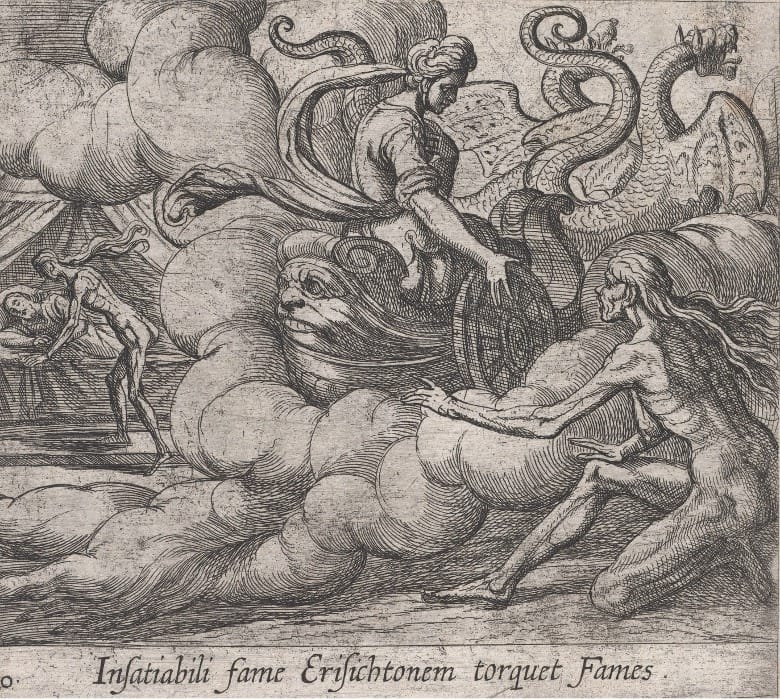
In stanzas 25-26, the goddess Ceres commands the spirit of Hunger to come and infect Erysichthon:
Bid Hunger
Take possession of Erysichthon’s belly.
Tell her she has power over all my powers
To nourish Erysichthon. Let all I pour
Or push down this fool’s gullet only deepen
His emptiness.
Notice the profound wisdom here. The punishment of insatiable hunger visited upon Erysichthon is actually a revelation of the sickness already in him! The greed that drives the King to cut down the sacred oak foreshadows the fatal toxic hunger that will follow. Even as the King swings at the tree, his inner disease is already at the grave stage. And as we think today about what motives drive the actions that endanger the environment, history will show greed to be the primary engine—insatiable greed to use the precious natural resources of the earth “to advance progress,” which is another way of saying “to secure ease,” which is another way of saying “to make money.”
What distinguishes greed from proper human desire is its insatiable character. As hunger consumes Erysichthon, stanzas 41-42 graphically portray his pathetic condition:
Emptying bowls of heaped food, all he craves for
Is bigger bowls heaped higher. Food
For a whole city cannot sate him. Food
For a whole nation leaves him faint with hunger.
Ovid/Hughes compares this hunger to the ocean, forever drinking the rivers and “draining the continents,” and to fire, which “grows hungrier the more fuel it finds.” In the modern quest for wealth, power, and advantage over others, there is no end to the consumer impulse. The calls for restraint and regulation only prod the greed-drive into higher gears until we, like Erysichthon, find nothing to be enough. The poem concludes:
Whatever he ate
Maddened and tormented that hunger
To angrier, uglier life. The life
Of a monster no longer a man. And so.
At last, the inevitable.
He began to savage his own limbs.
And there, at a final feast, devoured himself.
The tragic end of Erysichthon, no longer a man but a monster, is nothing less than the unimaginable act of autocannibalism. He eats himself to death. The term in cellular biology is autophagy and usually refers to a cell’s ability to eat and recycle the broken-down parts of its cellular mechanism. But taken poetically, the image is instructive. It tells us that the end of greed is to dissipate oneself under the spirit of manic consumption. People, like Esau of old, are everywhere selling their birthrights in order to take short cuts toward the ephemeral promise of more. Shortcuts are almost always disguised pathways into dire trouble.
The ancient wisdom pleads with the modern world to beware: cutting down the oak leads to self-extinction. And in this we are reminded that there is nothing new under the sun (Ecclesiastes 1:9), and the champions of progress best take note that the sacred oak in the middle of the story of the world is staring down the axe yet again. What will we do next? Will there be enough protesting Thessalians this time around to restrain the madness of the hungry king?
I welcome your comments below, or email me directly at windinthereedspub@gmail.com.
Jeff

The Ecological Disciple is part of Circlewood, an organization committed to "accelerating the greening of faith."

Comments ()